Back
Why Semiconductor and EV Battery Plants Are Building Meal Programs Into New Facility Launches

Semiconductor and EV battery plants are adding meal programs to facility launch plans because food access affects shift coverage, breakroom capacity, and the daily experience of a large workforce. Planning early lets the launch team reserve the right space and utilities, choose a service model for every shift, and assign ownership before production ramps.
The need is especially clear at greenfield sites in industrial corridors, where restaurant hours and travel time may not match short breaks or overnight schedules. CookUnity Business supports meal programs for facilities and manufacturing teams through on-site meal access models that can be scoped around headcount, shift patterns, and available breakroom space.
Key takeaways
Treat meals as a launch workstream with an owner, budget, timeline, and operating requirements.
Model demand by people on site at each break window, not by total employee count.
Keep food storage and dining areas separate from production zones where toxic materials may be present.
Choose a service model that covers nights, weekends, ramp-up swings, and contractor populations.
Pilot before full production so the team can adjust assortment, stocking, and subsidy rules with operating data.

Why are plants planning meals before opening day?
New semiconductor and EV battery plants must recruit and support large workforces while complex facilities move from construction through equipment installation and production ramp. A meal program touches space planning, utilities, access control, waste handling, vendor routes, and employee communications, so postponing it until opening day creates avoidable rework.
The scale can be substantial. In its November 2024 final-award announcement for TSMC Arizona, the National Institute of Standards and Technology listed about 6,000 direct manufacturing jobs across three greenfield fabs. The U.S. Department of Energy's 2022 environmental assessment for an Ultium Cells battery plant described an operating plan of three shifts per day, six days per week, with 1,522 employees at full staffing.
Those examples do not set a template for every project. They show why the meal question needs its own capacity model. A single headquarters-style lunch service cannot be copied into a site where construction crews, commissioning teams, technicians, engineers, and production workers arrive on different timelines.
Federal semiconductor guidance also puts workforce planning into the project process. NIST's CHIPS program says a strong workforce strategy includes needs assessment, recruitment and retention, job quality, metrics, and milestones. A meal program is not a CHIPS requirement, but it can sit alongside other practical workforce supports.
What makes food access at a 24/7 plant different from an office?
A 24/7 plant has several lunch periods spread across the day, including hours when local restaurants and staffed cafeterias may be closed. The program must serve each shift within its actual break window and avoid creating a line that consumes most of that window.
The Bureau of Labor Statistics reported in 2026 that 15 percent of U.S. wage and salary workers usually worked a non-daytime schedule in 2024-2025. Fixed posts, gowning or hygiene steps, and long walks can further reduce usable meal time at manufacturing sites.
Launch teams should map four variables by shift:
Peak headcount physically present, including contractors during commissioning
Break timing and the number of people released at once
Walking, gowning, and security time between the work area and meal location
Refrigeration, reheating, seating, and waste capacity at each break area
The operational goal is equitable access across shifts. Teams designing food access for night-shift manufacturing workers should define availability, service recovery, and restocking for evenings, nights, and weekends before selecting equipment.
Why should food access be part of facility design?
Food access belongs in facility design because the program needs a suitable location, storage, power, reheating equipment, waste service, and traffic flow. In semiconductor and battery manufacturing, the team must also keep food away from areas where production materials could create an exposure risk.
OSHA's general-industry sanitation standard, 29 CFR 1910.141, says employees may not consume or store food in toilet rooms or areas exposed to toxic material. It also requires employer-provided food service to follow hygienic handling and storage principles. Site EHS and legal teams should interpret the standard for the facility's specific processes and local requirements.
OSHA's battery manufacturing eTool makes the spatial point concrete. Its example hygiene facility separates the plant side from a lunchroom through work-clothes storage, shoe cleaning, vacuuming, and handwashing steps. The example is not a universal floor plan, but it shows why dining cannot be dropped into leftover space after production areas are set.
During design, facilities teams should confirm:
Which break areas can be reached within the scheduled window
How many refrigerated meals can be stored at peak demand
Whether electrical service and circuits support refrigeration and reheating equipment
Where handwashing and food-waste stations will sit
How restocking staff enter the site and move through security
Who cleans shared surfaces and responds to equipment issues on each shift
The article on breakroom food ideas for factories and warehouses can help teams translate the physical plan into an employee-facing assortment.
Which meal model fits a new plant?
The best model depends on demand frequency, headcount by shift, available space, and how much on-site administration the plant can support. Many facilities use more than one model, such as scheduled meals during construction and a stocked on-site option once operations become continuous.
Model | Best fit | Space and equipment | Staff time | Demand flexibility |
Staffed cafeteria | Large, stable populations with concentrated service periods | Kitchen, serving line, seating, utilities, and back-of-house space | High on-site operating load | Strong at planned peaks, less efficient during low-volume periods |
Scheduled group delivery | Training days, launch events, planned overtime, and fixed crew meals | Receiving point, refrigeration as needed, and meal distribution area | Moderate coordination for ordering and handoff | Good for known headcount, weaker for unscheduled demand |
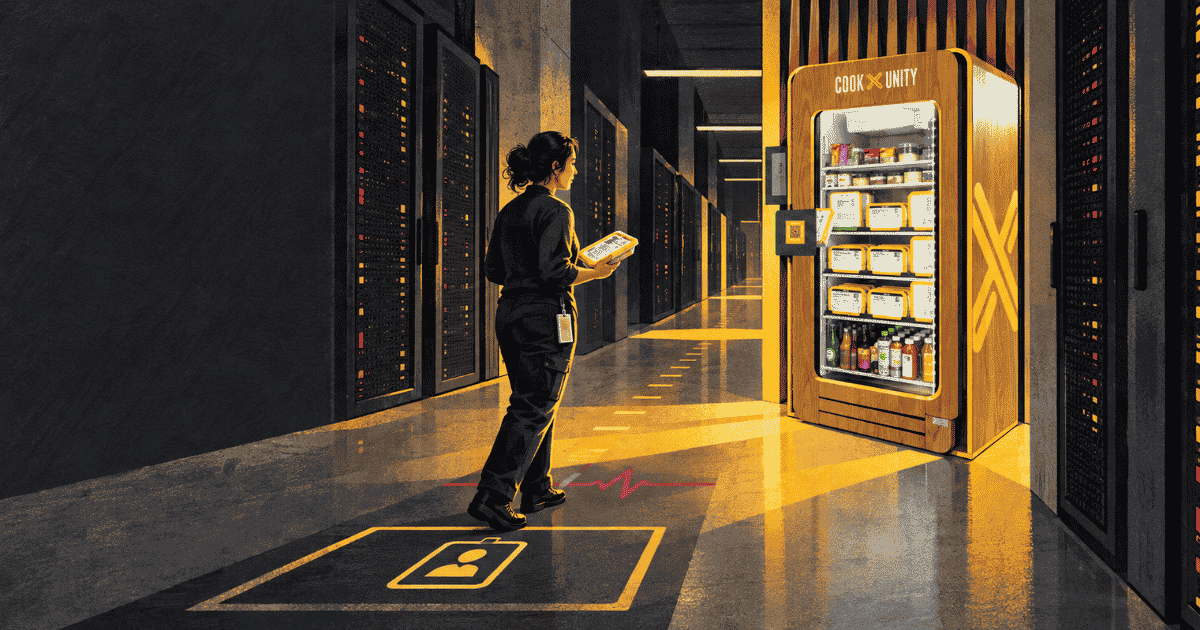
Stocked smart fridge | Multi-shift access with variable individual break times | Refrigerated unit, power, network or access setup, reheating, and waste stations | Lower daily coordination when vendor-managed | Good for staggered demand and off-hours access |
Traditional vending and pantry | Snacks, beverages, and supplemental access | Vending footprint, power, and waste stations | Low to moderate | Broad availability, but limited as a full-meal solution |
Compare options using cost per meal served, hourly demand, space, internal labor, waste, outage response, and employee access. For a closer model comparison, see smart fridges versus scheduled delivery for industrial facilities.
How should launch teams build the meal program?
Launch teams should start with the operating schedule, build a demand model, select locations and equipment, define the service policy, and test the system before production ramp. Each decision needs a named owner and a date tied to construction, hiring, or commissioning milestones.
1. Build a phased headcount model
Separate construction, commissioning, training, and steady-state operations. Estimate people present by shift and break period, with assumptions for contractors, overtime, and weekend work.
2. Assign cross-functional ownership
Facilities can own space and equipment while HR or workplace teams own the employee policy. Procurement should cover vendor terms and service expectations. EHS, security, IT, finance, and site operations should review the parts that touch their controls.
3. Define the employee experience
Decide who can use the program, when meals are available, whether the employer subsidizes the cost, and how employees pay or authenticate. Cover dietary information, accessibility, outages, and problem reporting.
4. Test before the full ramp
Run a pilot with representative shifts, including nights or weekends. Measure meals available, meals selected, stockouts, leftovers, transaction issues, queue time, and support tickets. Use the results to adjust stocking and operations before the employee population grows.
5. Set the operating rhythm
Name the person who reviews weekly demand, shift changes, outages, waste, and employee feedback. Establish escalation contacts for refrigeration, delivery, access, and food-quality concerns. Revisit the capacity model when a new production line or shift comes online.
How does CookUnity fit semiconductor and EV battery plants?
CookUnity fits facilities that need chef-prepared meals across staggered shifts without operating a full cafeteria at every service window. A CookUnity office smart fridge program can provide on-site access for employees whose breaks fall outside a scheduled delivery. Recurring meal delivery can support planned training, launch events, or satellite teams where a stocked fridge is not the right fit.
Programs can draw from meals prepared by 130+ chefs across the U.S. and Canada, with up to 400+ weekly meals in the largest markets and options across 60+ cuisines and diets. Exact assortment and service availability vary by market. The site still needs appropriate refrigeration, reheating, handwashing access, waste handling, and a designated eating area.
CookUnity pricing is per meal and scoped with the CookUnity team. During planning, the team can review shift coverage, site access, expected participation, available space, subsidy design, delivery cadence, and launch timing to recommend a program configuration.
Frequently asked questions
When should a new plant start planning its meal program?
Start during facility programming or schematic design, before breakroom locations, electrical capacity, and employee circulation are fixed. The service model can be selected later, but the team should reserve suitable dining and storage space early. Tie the decision calendar to hiring, commissioning, occupancy, and production-ramp milestones.
Does a semiconductor or battery plant need a full cafeteria?
No. The right model depends on headcount, shift timing, location, and internal operating capacity. A staffed cafeteria can fit a large, stable daytime population. Scheduled group delivery or a stocked smart fridge may fit staggered shifts, smaller buildings, satellite areas, or phases when demand is still changing.
How can a meal program cover night and weekend shifts?
Design availability around the least-served shift first. Confirm that meals are stocked before the shift, reheating equipment is available, and support exists if access or refrigeration fails. Include nights and weekends in the pilot, then compare stockouts and selection patterns by shift rather than relying on daytime results.
What infrastructure does an on-site meal program need?
Most programs need designated food storage and eating space, suitable refrigeration, power, reheating equipment, handwashing access, seating or eating surfaces, and waste handling. Requirements depend on the model and local rules. Facilities, EHS, legal, and local authorities should review the final design for the specific site.
How can a launch team budget before headcount stabilizes?
Use a phased model with low, expected, and high headcount by shift. Separate fixed facility costs from variable meal costs, then set review points at major hiring and production milestones. Ask vendors how ordering, stocking, subsidy rules, and service levels can change as the site moves from commissioning to steady operations.
Plants that plan meals alongside hiring, space, and shift operations can open with a defined food-access system instead of improvising after employees arrive. Talk to the CookUnity team about a facility meal program scoped to your launch schedule, workforce, and site.

Be the first to know about new offers
Multiorder discounts, free items and more.