Back
Kristy Del Coro, MS, RDN, LDN, Culinary Nutritionist at CookUnity, shares her expert take.
Every update to the Dietary Guidelines for Americans sparks debate, and that’s not a bad thing. Nutrition science evolves, and so should the guidance that shapes how we eat.
First and foremost, these guidelines are a framework more than a rulebook for how and what to eat and know that every "body" is different and may have individual needs.
However, I do feel when the government publishes dietary guidelines, they need to be primarily grounded in solid evidence. After all, there are plenty of health influencers and even our friends and family who can share anecdotal evidence for us. If we can’t rely on the government to provide the most science-backed recommendations, that concerns me.
This being said, the newest guidelines make some meaningful progress with its overall message about getting back to basics, driving home the importance of eating more minimally processed foods (named “real food” in the Guidelines), cooking more (including for adolescents), and prioritizing foods that benefit our gut microbiome.
But at the same time, there are areas where the messaging missed the mark and are not consistent with a large body of nutrition science.
Here’s where I land.
What I like
An emphasis on real food, especially plants and seafood
I strongly support the focus on fruits, vegetables, and whole, minimally processed foods. This is not a big departure from previous dietary guidelines which have always encouraged a foundation of fruits and vegetables, healthy proteins, and grains. But I like that this is still front and center and includes visuals of a variety of fresh, frozen and canned produce. The science here is clear: diets rich in plant foods are associated with lower risk of heart disease, type 2 diabetes, certain cancers, and overall mortality. These foods also provide fiber and phytonutrients that support gut health which is something I’m glad the guidelines are beginning to acknowledge more explicitly.
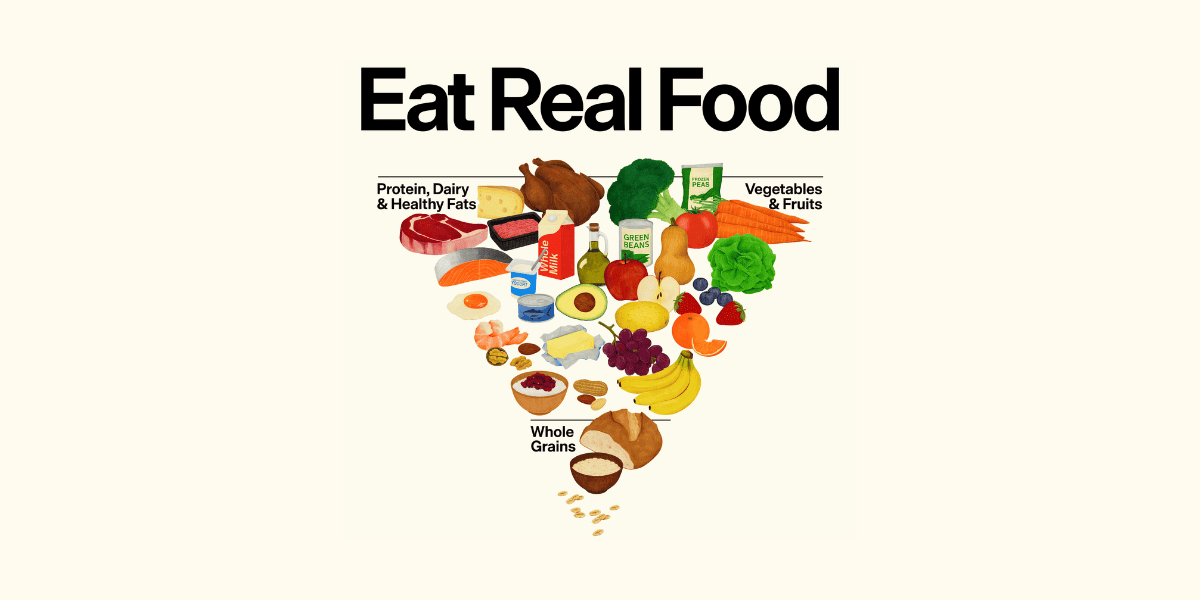
Gut health is foundational to metabolic health, immunity, and inflammation, and encouraging fiber-rich foods like produce, legumes, and whole foods is a step in the right direction. But I do wish whole grains were emphasized more clearly here instead of being at the bottom of the upside down pyramid; the majority of Americans fall significantly short of their daily fiber needs and would greatly benefit from eating more whole grains which also deliver plant based protein, healthy fats, B vitamins, essential minerals and phytochemicals.
I also appreciate the stronger emphasis on seafood. Seafood provides high-quality protein and omega-3 fatty acids and is consistently linked to improved cardiovascular health. Considering approximately 80-90% of Americans do not meet the previous dietary guidelines for eating seafood 2x per week, this is still something we clearly need to encourage.
Teaching food skills early
Another recommendation I also really like is encouraging adolescents to actively participate in food shopping and cooking. Cooking skills and food literacy are powerful predictors of diet quality later in life. When young people learn how to prepare food, build meals, and make choices based on taste, nutrition, and budget, healthy eating becomes a lifelong skill. I love that these new Dietary Guidelines call out the recommendation to “make cooking meals fun and a regular part of the household’s routine.”
Where I have concerns
Whole grains are undervalued in the graphic
While whole grains are recommended in the text that accompanies the visual diagram, I feel they appear deprioritized in the graphic, which is concerning. Whole grains are among the most well-studied foods in nutrition science and are associated with lower risk of heart disease, type 2 diabetes, colorectal cancer, and premature death. They’re also a major source of dietary fiber, which most Americans don’t get enough of. Downplaying whole grains risks reinforcing unnecessary fear around carbohydrates; however if people take time to read the recommendations thoroughly they will see it is identified as a priority.
Red meat, saturated fat, and mixed messages
My biggest concern is the elevation of red meat—especially when it’s grouped near foods associated with healthy fats.
The guidelines still recommend limiting saturated fat to less than 10% of daily calories, with organizations like the American Heart Association suggesting 5–6% for optimal heart health. Red meat is one of the primary sources of saturated fat in the American diet, and higher intakes of red and processed meat are consistently associated with increased risk of cardiovascular disease, type 2 diabetes, colorectal cancer, and all-cause mortality. Processed meats are classified as carcinogenic, and unprocessed red meat as probably carcinogenic when consumed in higher amounts. There is a call-out to limit processed foods high in sodium but there is no specific mention of limiting processed meats.
Positioning red meat alongside foods rich in unsaturated fats like olive oil, nuts, seeds, and seafood creates confusion. These foods improve cholesterol profiles when they replace saturated fat; red meat does not. The growing promotion of beef tallow adds to this inconsistency. Beef tallow is about 50% saturated fat, and using it regularly makes it nearly impossible to stay within recommended saturated fat limits especially when combined with other common sources like meat and dairy.
This doesn’t mean red meat must be eliminated. It means it should be consumed intentionally and in moderation, not positioned as a dietary foundation.
Dairy-centric guidance isn’t inclusive
Another limitation is the assumption that dairy is essential. Many people cannot eat dairy due to lactose intolerance, allergies, or digestive issues, and others choose to eat dairy-free for cultural or personal reasons. While dairy can be nutritious, the guidelines don’t provide equally clear guidance on meeting calcium, vitamin D, and protein needs without it, despite many viable plant-based options.
Sustainability, affordability, and access matter
The guidelines also fall short in addressing environmental sustainability and real-world access. Diets higher in red meat are more resource-intensive and less aligned with planetary health goals. At the same time, many recommended whole foods are expensive, time-consuming, or inaccessible for people managing tight budgets, busy schedules, or chronic conditions.
Healthy eating has to be realistic. Convenience, cost, and access matter.
Where CookUnity fits in
This is where thoughtfully prepared meals can help bridge the gap. At CookUnity, our chef-crafted meals are built around vegetables, whole ingredients, nutrient dense sustainably sourced proteins, and global flavors, making it easier to eat in line with nutritional guidance without needing the time or resources to cook everything from scratch. We can provide the convenience of a home-cooked meal without having to do it yourself every single night, every meal of the day.
Our goal is to turn the best of nutrition science into meals that people can actually enjoy and sustain, because better health starts with better food, made accessible. We also recognize that what works for one person may not work for another; so, remember, these guidelines are a framework, not a rulebook. We feel strongly that you should trust your own body’s needs and eat what makes you feel your best. This is why we try to offer as much variety as possible including meals strongly grounded in evidence-based nutrition science as well as meals that are more flexible for those with different calorie needs or those of you wanting higher protein or higher fat options.
Our medically tailored meals go even further, offering evidence-based nutrition designed to support specific health conditions while still prioritizing flavor and satisfaction. Food as medicine delivered to your door.
The bottom line
The new Dietary Guidelines make important progress especially in their emphasis on real food, gut health, seafood, and food skills for life. At the same time, elevating red meat, downplaying whole grains, overlooking dairy-free needs, ignoring issues around access to these nutritious foods, and omitting considerations of planetary health create gaps that matter.

Be the first to know about new offers
Multiorder discounts, free items and more.