Back
Do mushrooms have protein? How much, and what to pair them with
Yes, mushrooms have protein. Roughly 2 to 3 grams per 100 grams raw, which is about what a slice of bread gives you.
That number is the whole story if you came here planning to put a portobello where the chicken used to go. Mushrooms borrow meat's texture and its savory depth well enough that plenty of recipes lean on them to do exactly that job. The protein does not follow.
So the useful question is what goes next to them.
Do mushrooms have protein? The short answer
Mushrooms contain protein. They are not a protein food.
A cup of raw sliced white mushrooms, about 70 grams, carries roughly 2 grams. Per 100 grams, about 3. Three ounces of cooked chicken breast carries around 26. Eggs, Greek yogurt, tofu, tempeh, beans, lentils, and most fish land somewhere in between.
Mushrooms belong in a high-protein mushroom meal. They don't anchor one.
How much protein is in mushrooms
Per USDA nutrition data, one cup of raw sliced white mushrooms, about 70 grams, has roughly 2 grams of protein. A 100-gram portion, about 3 grams.
Variety shifts that a little. Cooking shifts it more, at least on paper. Mushrooms are mostly water, and cooking drives much of that water off, so a cup of cooked mushrooms holds far more actual mushroom by weight than a cup of raw. The protein in cooked mushrooms reads higher per cup because there is more mushroom in the cup.
When you compare mushroom nutrition facts across sources, check two things: the weight the numbers refer to, and whether the mushrooms are raw or cooked. Most of the confusion online comes from mixing those up.
Which mushrooms have the most protein
Per 100 grams raw:
Oyster mushrooms: about 3 grams
White button mushrooms: about 3 grams
Shiitake mushrooms: about 2 grams
Portobello mushrooms: about 2 grams
Maitake mushrooms: about 2 grams
Exact values move with the specific product, growing conditions, preparation, and which nutrition database you check.
The spread between the highest and lowest common variety is about a gram. Choose oyster over portobello because you prefer oyster mushrooms. It will not change your protein intake in any way you would notice. What you pair them with will.
Are mushrooms a complete protein
Protein is built from amino acids. Nine are essential, meaning your body cannot make enough on its own and food has to supply them.
Mushrooms contain essential amino acids. Whether any single plant food qualifies as "complete" is close to an academic question for anyone eating a varied diet, since amino acids pool across the day rather than per plate. Cover your total protein from a range of sources and the completeness question mostly answers itself.
So don't turn dinner into an amino-acid math problem. Treat mushrooms as one component and put a real protein next to them.
Can mushrooms replace meat
Mushrooms do a convincing job of meat's culinary work. Their umami carries burgers, tacos, ragùs, stir-fries, and grain bowls, and a portobello cap has enough structure to sit at the center of a plate without apologizing for itself.
Swap a chicken breast for that cap and the meal loses roughly 24 grams of protein while gaining none of it back.
Which is worth knowing if protein is one of your goals. The fix is not to give up the mushrooms. It's to decide what else is on the plate.
Why a plate full of vegetables leaves you hungry by nine
Roasted mushrooms, zucchini, peppers, spinach, broccoli. It looks like the meal you are supposed to be eating.
Depending on portions, a plate built almost entirely from non-starchy vegetables can come in well under what you need on protein, on calories, and on the fat and starch that make a meal hold. That's why it empties out faster than it should.
Mushrooms sit at the center of this misunderstanding because their texture reads as substantial. Feeling substantial and supplying 25 grams of protein are different things.
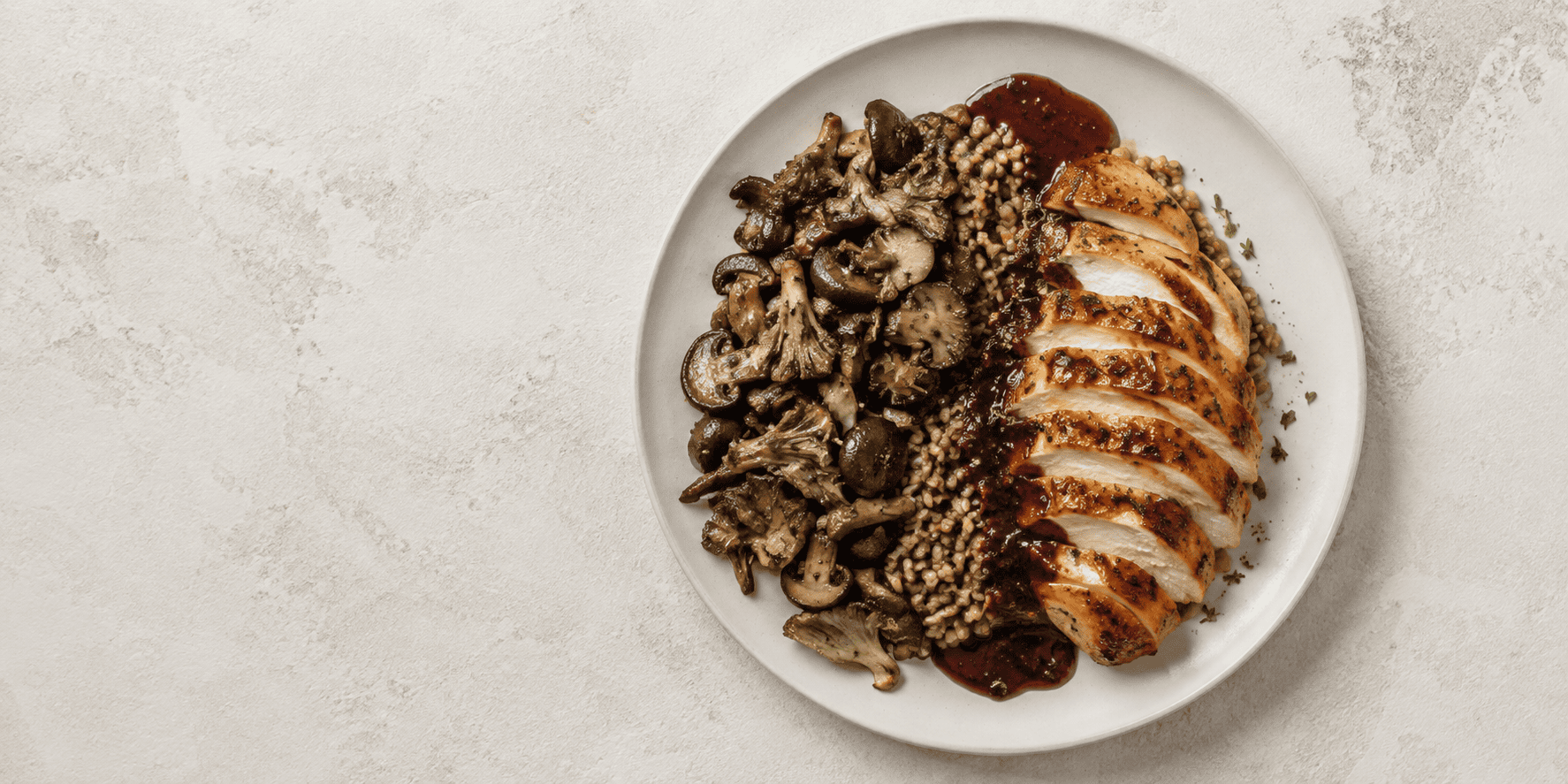
A mushroom meal that holds up has four parts: mushrooms and other vegetables for flavor and texture, a real protein source, a carbohydrate scaled to what you need, and enough fat or sauce to make the whole thing worth eating.
It also gets you out of the plain-chicken-and-broccoli rut, which is where most people land when they try to eat well without a plan.

Mushrooms, with something behind them
Meals from award-winning chefs where the mushrooms bring the flavor and the protein does the work. Every dish is individually portioned, with its protein, calories, carbs, and fat published.
→ See this week's menu
How to build a high-protein mushroom meal
Treat the mushroom as an ingredient and the protein as the anchor.
Chicken or turkey. The most obvious pairing and still the best one. Mushrooms disappear into pan sauces, grain bowls, and roasted trays alongside poultry.
Eggs. Omelets, frittatas, scrambles, breakfast bowls. Mushrooms bring the flavor, eggs bring about 6 grams apiece.
Tofu or tempeh. Both take bold seasoning, which works with the earthiness instead of fighting it. Tempeh is the denser of the two.
Lentils and beans. The most useful vegetarian protein pairings here, especially in soups, stews, tacos, and mushroom ragùs, where they also add fiber.
Fish and shellfish. Risotto, brothy pasta, anything where mushrooms and seafood can share a broth.
A Greek yogurt sauce. Adds creaminess and a few more grams in place of the cream you would otherwise reach for.
Stop counting the grams in the mushrooms. Count the grams in the meal.
The version where you don't build it yourself
Assembling that four-part mushroom meal from scratch is more shopping than it sounds. Mushrooms, a protein, a vegetable, a starch, seasoning, and a sauce. Cook for one or two people and you are buying full packages to use a quarter of.
CookUnity meals arrive with those parts already together. Mushrooms show up in dishes where the protein is doing the protein's job, and the nutrition for the finished dish is published, so you read one number instead of estimating six.
The other thing it fixes is repetition. Different chefs use mushrooms across different cuisines, sauces, and techniques, so the mushroom dish in week three doesn't taste like the one in week one.
The pairing, already done
Mushroom dishes built as complete meals by award-winning chefs. Protein, starch, and sauce already sorted, full nutrition on every dish, ready in minutes.
→ Browse this week's menu
From award-winning chefs. Restaurant-quality, every meal.
Frequently asked questions about protein in mushrooms
Do mushrooms contain protein
Yes. Roughly 2 to 3 grams per 100 grams raw, depending on variety. That is enough to count toward your day and not enough to build a meal around.
Are mushrooms a good replacement for meat
They replace meat's texture and savory depth in a recipe. They do not replace its protein. If you swap meat for mushrooms, add another protein source to the meal.
Why do mushroom meals sometimes leave you hungry
A meal built mostly from mushrooms and other vegetables can fall short on protein, calories, fat, and the starch that makes a meal last. Pair the mushrooms with a protein source and a carbohydrate and the meal holds.
How can I make a mushroom meal higher in protein
Pair mushrooms with chicken, turkey, eggs, tofu, tempeh, lentils, beans, seafood, or a Greek yogurt sauce. Which one depends on what you eat and what you are cooking.
Which mushrooms have the most protein
Oyster and white button mushrooms sit at the top of the common varieties, around 3 grams per 100 grams raw, with shiitake, portobello, and maitake around 2. No common mushroom is protein-dense.

Be the first to know about new offers
Multiorder discounts, free items and more.