Back
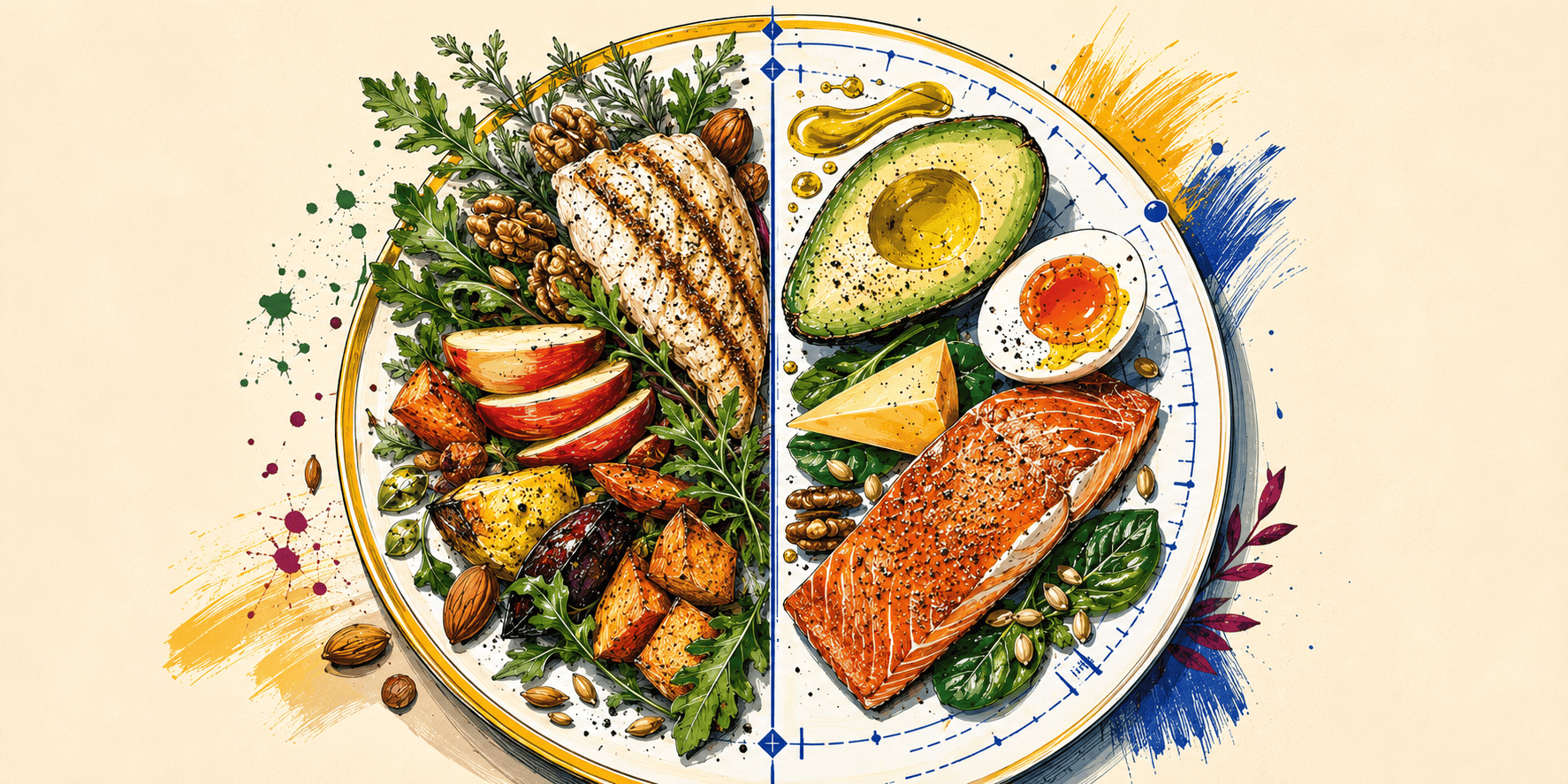
Paleo and keto can look similar from across the grocery store, but they are built on different ideas. Paleo is a whole-food approach inspired by pre-agriculture eating patterns, while keto is a very low-carb, high-fat diet designed to keep your body in ketosis.[1][2]
That difference matters more than the internet likes to admit. One approach asks, "Would this count as a whole, ancestral-style food?" The other asks, "Will this keep carbs low enough to stay in ketosis?" If you are deciding between the two, that one distinction changes what ends up on your plate, how much planning you need, and how easy the diet feels on a Wednesday when life is moving fast.
Key takeaways
Paleo focuses on whole foods like meat, fish, eggs, vegetables, fruit, nuts, and seeds, while cutting grains, legumes, dairy, and most processed foods.[1]
Keto is built around very low carbohydrate intake, usually about 20 to 50 grams per day, so the body relies more on fat and ketones for fuel.[2][3]
Paleo usually gives you more flexibility with fruit and carbs. Keto is stricter and more numbers-driven.
Both can support weight loss, especially when they replace ultra-processed, convenience-heavy eating patterns.[1][4][5]
For many people, the best diet is the one they can follow without turning every meal into a part-time job.
What is the keto diet?
The keto diet is a very low-carbohydrate, high-fat eating pattern designed to shift the body into ketosis, a state where ketone bodies become an important fuel source when glucose from carbs is tightly restricted.[2][3] In many clinical and consumer definitions, that means keeping carbs to roughly 20 to 50 grams per day, with fat making up the majority of calories.[2][3]
A typical keto plate includes meat, fish, eggs, cheese, avocado, oils, nuts, and lower-carb vegetables. Foods like bread, rice, beans, most fruit, and starchy vegetables usually do not make the cut because they push carb intake too high.[2][3]
Paleo vs keto: the key differences
At a glance, both diets tell you to walk past the bread basket and think harder about what counts as real food. The split shows up once you look at carbs, dairy, fruit, and the actual goal of the diet.
Carb limit: Paleo is flexible and usually much higher than keto. Keto usually lands around 20 to 50 grams of net carbs per day.[2][3]
Fat emphasis: Paleo is not inherently high-fat. Keto is deliberately high-fat.
Dairy: Paleo usually excludes dairy.[1] Keto often allows it.
Fruit: Paleo allows fruit.[1] Keto usually limits it to smaller, lower-carb options.
Legumes and grains: Paleo excludes both.[1] Keto excludes grains and usually avoids legumes because of carbs.
Purpose: Paleo is a whole-food, ancestral-style philosophy. Keto is a carb-restriction strategy designed to maintain ketosis.[2]
The simplest way to put it is this: paleo cares most about food origin and food quality, while keto cares most about carb restriction.
That is why an apple works on paleo but usually not on keto. It is also why cheese can fit into keto but not paleo. One diet is asking whether a food fits the philosophy. The other is asking whether the math works.
If you want a practical shortcut into the food side of the equation, check out our paleo meal delivery and keto meal delivery services and start eating actual meals, not just chasing nutrition labels.
Paleo vs keto for weight loss
Both diets can help with weight loss, but they tend to get there in different ways.
Keto often produces faster early results because severe carb restriction can reduce glycogen stores and the water that comes with them, on top of lowering overall calorie intake for some people.[4][5] Meta-analyses have found that very-low-carbohydrate ketogenic diets can improve weight-loss outcomes compared with low-fat diets in some studies, especially in the shorter term, though long-term superiority is less settled.[4][5]
Paleo can also support weight loss, largely because it replaces many refined, convenience-heavy foods with more filling whole foods.[1][6] Evidence from randomized trials and meta-analyses suggests paleo-style eating can improve body weight and waist circumference, but the research base is still smaller and less standardized than people often assume.[1][6]
So if the question is paleo vs keto for weight loss, the honest answer is not "one always wins." Keto may feel more dramatic at first. Paleo may feel easier to live with if you do not want to police every berry or count every carb gram. The biggest lever for either plan is still consistency.
Can you do paleo and keto at the same time?
Yes. Some people combine the two and call it paleo keto or a paleolithic ketogenic approach.
Usually that means keeping keto-level carbs while also following paleo-style food rules. So you are not just skipping grains and sugar. You are also cutting foods keto often allows, like most dairy products and many packaged low-carb substitutes. It is doable, but it is undeniably narrow.
That is exactly where meal planning can start to feel like a personality test you never asked to take. The more boxes you need a meal to check, the more helpful it becomes to start with options that are already filtered for you.
Which diet is easier to stick to?
For most people, paleo is easier to stick to.
Keto asks for more day-to-day precision. You usually need to track carbs closely, watch portion sizes on foods that seem harmless, and think about ketosis every time you eat. That structure can feel motivating if you like hard lines. It can also get old fast if your schedule is messy or your meals are usually improvised.[3]
Paleo is more flexible, especially if fruit, root vegetables, and a little breathing room matter to you. That said, it still cuts entire food groups, including grains, legumes, and dairy, so it is not exactly casual.
In other words, neither diet is effortless. The one that feels easier is usually the one that matches how you actually eat, not how you imagine your best self might eat on a Sunday night.
How CookUnity makes paleo and keto easier
This is where theory meets the week you are actually having.
CookUnity gives you access to chef-prepared paleo and keto meals that are already built for real life. Instead of planning, shopping, cooking, and cleaning around a restrictive framework, you can filter meals by diet, check macros before you order, and switch between approaches without rebuilding your entire routine.
That matters because adherence usually falls apart in the boring moments, not the dramatic ones. It happens when dinner sneaks up on you, when your fridge looks bleak, or when you want something that fits your goals without tasting like punishment. CookUnity helps close that gap with meals made by real chefs, real variety, and a lot less friction.
If you are paleo one month, keto the next, or somewhere in between, you do not need to start from scratch every time your priorities shift. You just need better options on hand.
FAQ
Is paleo or keto better for weight loss?
Keto may lead to faster early weight loss for some people, especially because carb restriction can quickly reduce stored glycogen and water weight.[4][5] Paleo can still work well for weight loss, and for many people it is easier to sustain because it allows more flexibility with fruit and overall carbs.[1][6]
Can you do paleo and keto at the same time?
Yes. Some people combine paleo food rules with keto carb limits, often called paleo keto. It is more restrictive than either diet alone, so convenience and meal planning matter even more.
Is paleo lower carb than keto?
No. Paleo is often lower in carbs than a standard American diet, but it is usually much higher in carbs than keto because it allows fruit and more starchy vegetables.[1][2] Keto is specifically designed to keep carbs low enough to maintain ketosis.
Conclusion
If you want the shortest possible answer, here it is: paleo is a whole-food philosophy, and keto is a carb-restriction strategy.
The better choice depends on what you value more. If you want more flexibility and fewer numbers, paleo may fit better. If you want a stricter low-carb structure, keto may be the better match. Either way, the easier your meals are to follow, the better your odds of sticking with it long enough to matter.
Sources
[1] NCBI Bookshelf. Paleolithic Diet. https://www.ncbi.nlm.nih.gov/books/NBK482457/
[2] JAMA Network. Ketogenic Diets. https://jamanetwork.com/journals/jama/fullarticle/2759475
[3] PubMed. Does a Ketogenic Diet Have a Place Within Diabetes Clinical Practice? Review of Current Evidence and Controversies. https://pubmed.ncbi.nlm.nih.gov/37966583/
[4] PubMed. Very-low-carbohydrate ketogenic diet v. low-fat diet for long-term weight loss: a meta-analysis of randomised controlled trials. https://pubmed.ncbi.nlm.nih.gov/23651522/
[5] PubMed. Effects of ketogenic diet on health outcomes: an umbrella review of meta-analyses of randomized clinical trials. https://pubmed.ncbi.nlm.nih.gov/37231411/
[6] PubMed. Influence of Paleolithic diet on anthropometric markers in chronic diseases: systematic review and meta-analysis. https://pubmed.ncbi.nlm.nih.gov/31337389/

Be the first to know about new offers
Multiorder discounts, free items and more.